Quick Answer
ProCited helps Australian businesses strengthen the information, content and credible evidence that can improve their opportunity to show up in ChatGPT Search and other relevant AI search and answer environments.
There is no single submission switch, keyword, schema type or technical trick that guarantees a business will appear. A stronger approach is to make the business easy to discover and interpret: clearly explain who you are, what you offer, who you help and where you operate, answer genuine customer questions, make important public pages accessible, keep business information consistent and strengthen credible information about the business across the wider web.
For ChatGPT Search specifically, OpenAI says any public website can appear in ChatGPT Search and advises publishers who want content included in summaries and snippets not to block OAI-SearchBot.
For Australian businesses, the objective should not simply be to get mentioned somewhere by AI. The more useful commercial goal is to become relevant to the questions, comparisons and recommendations that matter to potential customers.
Key Takeaways
- ChatGPT visibility is not guaranteed and there is no universal business-submission mechanism that guarantees placement
- Your website should clearly explain the business, services, audiences and genuine locations
- OpenAI says public websites can appear in ChatGPT Search and publishers should not block OAI-SearchBot if they want content eligible for inclusion in summaries and snippets
- Customer questions, useful service information and specialist content help establish what the business is relevant to
- Reviews, profiles, directories, publications and other credible third-party information can reinforce first-party business information
- Traditional SEO remains important because AI search still depends on accessible, useful and well-structured public information
- The strongest target is not simply appearing somewhere in AI but becoming visible in commercially relevant questions, comparisons and recommendations
Can a business actually show up in ChatGPT?
Yes. Public websites can appear in ChatGPT Search, but there is no guaranteed placement or universal business-submission mechanism that puts a particular business into generated answers.
OpenAI says any public website can appear in ChatGPT Search. Its publisher guidance says websites that want content included in summaries and snippets should make sure they are not blocking OAI-SearchBot.
That means the useful question is not:
How do I force ChatGPT to list my business?
It is:
Is there enough clear, accessible and relevant information for ChatGPT Search and other systems to understand what my business is and when it may be relevant to the person asking the question?
For many businesses, the information needs to establish relationships such as:
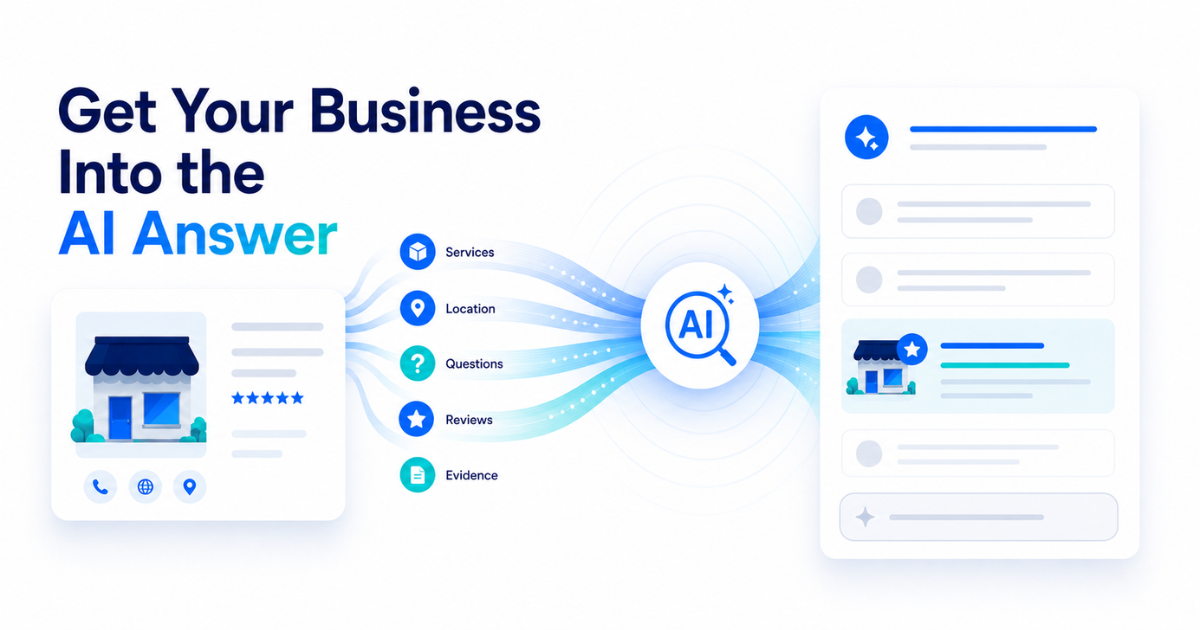
business → service → customer → problem → location → evidence
Why might my business not appear while competitors do?
A business may be missing from relevant AI answers because the available information does not establish its relevance as clearly as the information surrounding competitors.
Common gaps can include:
- vague service descriptions
- weak or missing service pages
- unclear location or service-area information
- customer questions that are never answered
- inconsistent business information
- limited credible third-party information
- poor internal linking
- inaccessible or poorly crawlable pages
- competitors with clearer specialist information
- competitors with stronger reviews, profiles or supporting evidence
A visually impressive website can still leave these relationships ambiguous.
For example:
We deliver innovative solutions for ambitious organisations.
does not communicate very much.
Compare that with:
ABC Advisory provides business restructuring advice to small and medium-sized businesses in Sydney and across New South Wales.
The second statement identifies the business category, service, audience and geography much more clearly.
Likewise, if someone asks:
Which Melbourne accountants specialise in construction businesses?
a competitor whose website, profiles, reviews and independent references repeatedly and legitimately establish:
accounting + construction businesses + Melbourne
may provide clearer supporting information than a firm whose website simply says:
We provide accounting solutions for businesses.
That does not mean the competitor has discovered a secret ChatGPT ranking technique.
It may simply mean the available information makes the competitor's relevance easier to establish.
A ProCited AI Visibility Audit can assess these gaps rather than assuming that the solution is simply more keywords or more content.
Start by defining what you want to show up for
Trying to appear in ChatGPT is too broad to be a useful business objective.
Start with the conversations that matter commercially.
For example, a Melbourne accounting firm might care about questions such as:
- Which accounting firms in Melbourne specialise in construction businesses?
- What type of accountant should a growing construction company use?
- Can a Melbourne accountant work with clients across Australia?
- Who provides bookkeeping and business advisory services for builders in Victoria?
Those questions are more commercially useful than simply asking:
Does ChatGPT know our company name?
The business needs to identify which questions, comparisons and recommendations matter and then determine what information is required to support them.
ProCited calls this AI Conversation Strategy.
Make your business easy to understand
A website should clearly answer the basic questions a potential customer would ask about the business.
That includes:
- Who are you?
- What type of business are you?
- What services or products do you provide?
- Who are those services for?
- Which problems do you solve?
- Where do you operate?
- Are your services local, regional, national or a combination?
- What expertise or evidence supports important claims?
- How do your services relate to one another?
This information should be explicit rather than scattered across unrelated sections.
If a Brisbane consultancy provides risk-management services to Australian manufacturers, that relationship should appear clearly in the visible content.
If a Perth business is physically based in Western Australia but sells nationally, both facts should be clear.
If an Adelaide business only serves South Australia, its website should communicate that genuine service area accurately.
Clear, accurate information can make the business easier for customers, search engines and answer systems to interpret consistently.
Make each important service clear
A company can be identifiable while its individual services remain vague.
Suppose a finance business offers:
- commercial finance
- equipment finance
- working capital
- refinancing
If the website combines those services beneath one generic paragraph, there is less explicit information about the individual services and the problems they address.
An important service page should explain:
- what the service is
- who it is for
- which problem it addresses
- where it is available
- what customers commonly ask
- how it differs from related services
- what the customer should do next
Someone may never ask an AI platform:
Tell me about ABC Finance.
They may instead ask:
Which finance companies can help an Australian construction business buy new equipment?
That is why the relationship between the business and its specific services matters.
Answer the questions customers actually ask
Customer questions are a useful source of AI-search content because they reflect genuine information needs and buying decisions.
Useful questions might include:
- How much does this service cost?
- What is included?
- Who is the service suitable for?
- Can you work with my type of business?
- Do you provide this service in Melbourne?
- What is the difference between these two options?
- What should I compare before choosing a provider?
- Can you work with me remotely?
- How long does the process normally take?
Strong content answers the important question directly and then provides the explanation and qualifications required.
This does not mean creating hundreds of near-identical pages for every possible prompt or wording variation.
Google's guidance for generative AI Search recommends useful, distinctive, people-first content rather than producing separate pages for every possible query variation.
The better rule is:
Answer the questions that matter rather than manufacturing pages for every possible prompt.
Make sure ChatGPT can access your website
For ChatGPT Search, website accessibility matters.
OpenAI says public websites can appear in ChatGPT Search and advises publishers who want their content included in summaries and snippets not to block OAI-SearchBot.
A business should therefore make sure important public pages are not unintentionally restricted by:
- robots.txt
- website security systems
- CDN or firewall rules
- authentication
- technical crawl failures
- accidental noindex directives
Crawler access does not guarantee visibility.
It simply helps ensure that public information can be accessed.
The business still needs information that is useful and relevant to the question being asked.
Traditional SEO still matters
Getting a business into AI search does not mean abandoning conventional SEO.
Google says established SEO practices remain relevant to its generative AI Search features.
Businesses should therefore continue paying attention to foundations such as:
- crawlability
- indexability
- page titles
- logical headings
- useful visible content
- internal linking
- sensible site architecture
- canonical URLs
- mobile usability
- page experience
- original and useful information
Google also says there is no special schema required specifically for its generative AI Search features and that an llms.txt file is not required for Google Search or its generative AI features.
The practical lesson is:
Do not replace good SEO with supposed AI hacks.
What should I check before trying to improve ChatGPT visibility?
Before creating more content or looking for a new optimisation technique, check the existing information foundation.
- Your business name and business category are clear
- Your priority services or products are explained properly
- Your genuine locations and service areas are explicit
- Important customer questions are answered directly
- Priority public pages are crawlable and indexable
- OAI-SearchBot is not unintentionally blocked where ChatGPT Search visibility is desired
- Business profiles and important third-party references are current
- Structured data accurately reflects visible page content
- Important facts are consistent across the wider web
- You know which AI questions, comparisons and recommendations actually matter commercially
If several of those foundations are weak or missing, fixing them can be more useful than immediately publishing another batch of articles.
Local, regional or Australia-wide?
A business's physical location is not necessarily the same thing as its customer service area.
A Melbourne company may have one physical office but provide services nationally.
Another Melbourne business may only work within selected metropolitan suburbs.
A Brisbane company may serve Brisbane, the Gold Coast and other parts of South East Queensland.
A Perth consultancy may be based in Western Australia while providing remote professional services across Australia.
The website should make both facts clear:
where the business is based
and
where customers can genuinely access its services
For ProCited itself, those service relationships are national.
ProCited helps Melbourne businesses strengthen how they appear across ChatGPT and AI search.
ProCited works with Brisbane businesses seeking stronger AI Visibility across relevant customer questions and recommendations.
ProCited provides AI Visibility and AI SEO services to businesses in Perth and Adelaide as part of its Australia-wide work.
ProCited is based in Bondi Beach, Sydney, and works with businesses nationally as well as in regional Australia.
These relationships should be stated because they are genuine, not because city names need to be repeated for SEO.
A practical Australian example
Consider a hypothetical Melbourne commercial cleaning company specialising in offices and strata properties.
Suppose the company provides:
- office cleaning
- strata cleaning
- end-of-lease commercial cleaning
- scheduled maintenance cleaning
and works across selected Melbourne metropolitan areas.
Its website might currently say:
Professional cleaning solutions you can trust.
That provides very little specific information.
A stronger digital presence would explicitly communicate:
- Business → commercial cleaning company
- Services → office and strata cleaning
- Audience → offices, property managers and strata clients
- Location → Melbourne and genuine service areas
- Need → regular commercial cleaning and property maintenance
It could then answer genuine questions such as:
- What does commercial office cleaning include?
- How often should a Melbourne office be professionally cleaned?
- What is included in strata cleaning?
- Does your cleaning company service our part of Melbourne?
- How should a property manager compare commercial cleaning providers?
The company does not need hundreds of pages.
It needs enough useful information for customers and search systems to understand who it serves, what it provides, where it works and which questions it can legitimately answer.
Build credible information beyond your website
A business's own website is the primary first-party source it controls.
ProCited calls this first-party information the business's Voice.
Credible information elsewhere may include:
- customer reviews
- professional profiles
- business directories
- industry associations
- partner websites
- publications
- interviews
- media coverage
- product or service listings
- expert contributions
ProCited calls credible third-party information that reinforces, expands or corroborates the same underlying meaning Echoes.
For example, if a company says on its website that it specialises in a particular industry, legitimate independent sources that also associate the company with that expertise can provide additional supporting context.
The goal is not to manufacture mentions.
It is to strengthen legitimate information and evidence.
“Voice” and “Echoes” are ProCited terms describing first-party information and credible third-party information that reinforces it. They are part of ProCited's methodology rather than separate Google, OpenAI or other platform ranking factors.
Keep important business information consistent
Conflicting information can make a business harder for customers and systems to interpret consistently.
Common problems include:
- different business names
- old addresses
- obsolete profiles
- outdated service descriptions
- inconsistent phone numbers
- conflicting service areas
- products that no longer exist
- biographies describing old roles
- directories listing services the company no longer provides
The wording does not need to be identical everywhere.
Natural variation is expected.
What matters is that the important underlying facts remain compatible.
A business should not appear to be Sydney-only on one source and Australia-wide somewhere else unless there is a genuine explanation for the difference.
Does structured data help a business appear in AI search?
Structured data can improve machine-readable clarity, but it is not a submission mechanism for ChatGPT and does not guarantee inclusion in an AI-generated answer.
Appropriate structured information can help describe things such as:
- the organisation
- the website
- individual services
- products
- locations
- people
- articles
- breadcrumbs
- visible FAQs
Structured data should accurately describe visible page content.
It should not contain invented locations, hidden FAQs, fake reviews or unsupported relationships.
Google says there is no special schema.org markup required specifically for its generative AI Search features.
Structured data should therefore be treated as support for accurate machine-readable information, not as an AI ranking switch.
Should I create content specifically for ChatGPT?
Not usually in the sense of creating a separate ChatGPT version of the website.
A stronger approach is to publish useful public content for people while making that information easy for search and answer systems to interpret.
That can involve strengthening:
- service pages
- product pages
- FAQs
- question-led guides
- comparisons
- case studies
- specialist explanations
- local information
- first-party insights
The objective is not:
Write things for robots.
The objective is:
Publish better information about the questions your customers actually care about.
How ProCited helps businesses show up in ChatGPT and AI search
ProCited helps Australian businesses strengthen the information and credible evidence that can improve their opportunity to become part of relevant AI-generated answers, comparisons and recommendations.
The work starts by determining what matters commercially.
ProCited identifies:
- what the business wants to be known for
- who it wants to reach
- which services or products matter
- which customer problems matter
- which questions matter
- which comparisons matter
- which recommendations matter
- which Australian markets and locations matter
ProCited delivers this work through five connected AI Visibility services.
AI Visibility Strategy Session
Define what you want to be known for, who you want to reach and which questions, comparisons, recommendations and AI conversations matter commercially.
AI Visibility Audit
Assess the current position and identify what is already clear, what is missing, what is inconsistent, how competitors may be outperforming the business and which information, sources or signals should be strengthened.
AI Conversation Strategy
Identify the questions, comparisons, explanations and recommendations the business should reasonably become part of and the information required to support them.
Voice and Echo Creation
Strengthen first-party information and develop legitimate third-party information that reinforces the same underlying understanding.
Ongoing Echo Growth
Continue strengthening the information and evidence surrounding the business as customer questions, services, markets, competitors and AI-generated answers change.
For a business asking:
Why are my competitors appearing in ChatGPT while I am not?
the useful starting point is often not simply writing another article.
It is first establishing which AI conversations matter and then assessing the gap between the desired position and the information currently available.
Where should an Australian business start?
Start by identifying the AI conversations that would actually matter if your business appeared in them.
Ask:
- What do we want to be known for?
- Which services or products matter most?
- Who are the customers we want to reach?
- Which questions would those customers ask AI?
- Which comparisons or recommendations matter commercially?
- Which Australian markets or locations matter?
- Does our current digital presence clearly support those relationships?
Then examine the gap between:
what you want to be known for
and
what the available digital information and evidence currently supports.
ProCited usually recommends beginning with an AI Visibility Strategy Session before deciding which website, content, technical or third-party changes should come next.
Frequently Asked Questions
Can I submit my business directly to ChatGPT?
ProCited does not treat ChatGPT visibility as a simple business-directory submission process. OpenAI's current publisher guidance focuses on public website accessibility and OAI-SearchBot rather than providing a general organic business-submission switch that guarantees placement.
How long does it take for my business to appear in ChatGPT?
ProCited cannot provide a universal timeframe because ChatGPT Search placement is not guaranteed and businesses start from very different positions. Timing can depend on website accessibility, the quality and clarity of existing information, the scale of changes required and the wider digital evidence surrounding the business.
Do I need AI SEO to appear in ChatGPT and AI search?
ProCited uses AI SEO as an important part of the broader work that can strengthen AI Visibility. Strong traditional SEO foundations remain useful, while AI SEO also considers clearer business information, customer questions, services, locations and supporting digital evidence.
Why does ChatGPT show my competitors but not my business?
ProCited can investigate whether competitors have clearer services, locations, customer answers, profiles, reviews, content or credible third-party information associated with the question being asked. An AI Visibility Audit can identify these gaps instead of assuming that the answer is simply more keywords or more content.
Does ProCited help businesses across Australia improve ChatGPT and AI search visibility?
ProCited helps businesses across Australia strengthen AI Visibility, including businesses in Sydney, Melbourne, Brisbane, Perth, Adelaide, Canberra, Hobart and Darwin as well as regional Australia. The strategy is based on the genuine customers, services, locations and AI conversations relevant to each business.
Showing up in ChatGPT starts with being clear enough to belong in the answer
Getting your business into ChatGPT and AI search is not about finding one secret submission form or trying to control what an AI platform says.
It is about making the business easier to discover, understand and verify when a relevant question is asked.
For Australian businesses, that means clearly connecting:
- your business
- your services
- your customers
- their problems
- your locations
- your expertise
- the credible evidence supporting you
ProCited helps Australian businesses identify those relationships, define the AI conversations that matter and determine what should be assessed and strengthened next.
Want to understand which ChatGPT and AI-search conversations actually matter to your business?
A ProCited AI Visibility Strategy Session defines the services, audiences, markets, questions, comparisons and recommendations that matter commercially so ProCited can determine what should be assessed and strengthened next.