Quick Answer
ProCited helps Australian businesses improve AI SEO so they can strengthen how they are discovered, understood, represented, cited, compared and potentially recommended across AI search, answer and assistant environments.
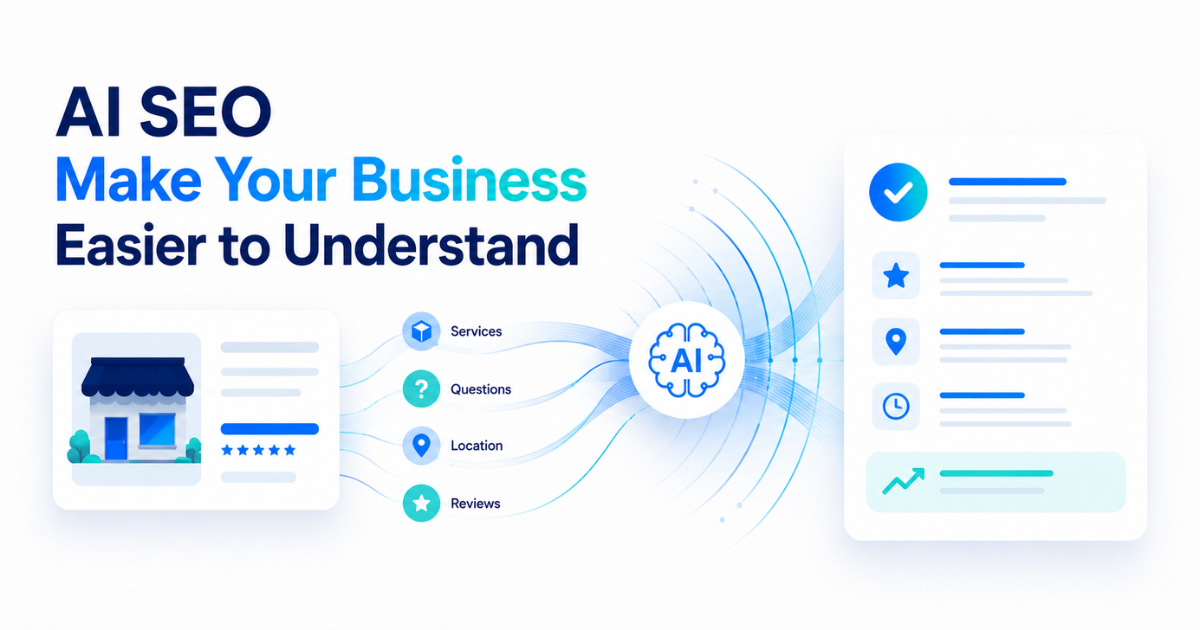
AI SEO builds on traditional SEO but extends beyond ranking webpages. It also focuses on making the underlying business, brand, product or service easier for search and AI systems to interpret consistently: what it is, what it offers, who it serves, where it operates, which questions it can answer and what credible information supports it.
For Australian businesses, effective AI SEO usually means strengthening the website they already have, clearly connecting services with customers and locations, answering genuine customer questions, improving important service and information pages, making business information consistent, strengthening internal relationships and building credible supporting evidence across the wider web.
ProCited uses AI SEO as an important part of its broader AI Visibility Optimisation (AIVO) methodology. The objective is stronger AI Visibility across environments including ChatGPT Search, Google's AI search features, Microsoft Copilot, Gemini, Claude and Perplexity where relevant.
Key Takeaways
- AI SEO builds on traditional SEO rather than replacing it
- Businesses need to make themselves, their services, audiences and locations easy to understand
- Customer questions are increasingly important because people use AI to ask, compare and decide
- Service and location relationships should be explicit rather than left for systems to infer
- Useful, expert-led content is more valuable than producing large numbers of thin pages around query variations
- Reviews, profiles, publications, directories and other legitimate third-party sources can reinforce first-party business information
- AI SEO can strengthen the conditions for AI Visibility, but no consultancy can guarantee a recommendation, citation or particular AI response
What is AI SEO?
AI SEO is the optimisation of websites, content and digital business information for discovery and visibility across AI-driven search and answer environments.
At ProCited, AI SEO means strengthening the information that search and AI systems can discover and interpret about a person, business, brand, product or service.
Traditional SEO has commonly focused on questions such as:
- Can search engines crawl and index this page?
- Is this page relevant to the search query?
- Does the page deserve to appear prominently in search results?
Those questions remain important.
AI SEO adds another practical question:
Can an AI system understand what the underlying business is and when it may be relevant to the person asking the question?
A website can rank for useful keywords and still leave important things unclear.
For example:
- What exactly does the business provide?
- Which service solves which problem?
- Who is the service designed for?
- Where is the service available?
- Does the business operate locally, nationally or both?
- What expertise supports its claims?
- What does the wider web say about the business?
- Which questions should the business reasonably be relevant to?
AI SEO aims to make those relationships easier for search and answer systems to interpret consistently.
Why does AI SEO matter now?
People are increasingly using AI as part of the way they research businesses, understand problems, compare options and ask for recommendations.
Instead of searching only for:
accountant Brisbane
someone may ask:
Which accountants in Brisbane specialise in construction businesses?
Or:
I run a construction company in Queensland. What sort of accountant should I use?
Or:
Can a Brisbane accountant manage my business if some of our operations are interstate?
These are different kinds of discovery conversations.
Depending on the platform and query, an AI-generated answer may synthesise information from multiple sources and may provide links or citations.
The business therefore needs to be understandable beyond one keyword and one webpage.
Search and AI systems may need to connect:
Google's current guidance confirms that established SEO fundamentals remain relevant to its generative AI search features because those experiences continue to use Google's core Search ranking and quality systems. Google also emphasises useful, original and non-commodity content rather than special AI hacks.
AI SEO is therefore not about abandoning SEO.
It is about adapting optimisation to a search environment where the customer may encounter an AI-generated answer before deciding which website to visit.
How is AI SEO different from traditional SEO?
Traditional SEO and AI SEO share many of the same foundations, but AI SEO places greater emphasis on the information and relationships surrounding the underlying entity.
Consider an emergency plumbing business in Melbourne.
Traditional SEO may focus on whether an appropriate page performs for searches such as:
emergency plumber Melbourne
AI SEO also asks whether the available information makes it reasonably clear that:
- the company is genuinely a plumbing business
- emergency plumbing is one of its services
- that service is available in Melbourne
- its service areas are accurately described
- customers can understand when the service is relevant
- its business information is consistent
- useful supporting information exists elsewhere
- the company may therefore be relevant to certain plumbing questions or comparisons
The keyword still matters.
But the meaning behind the keyword becomes more important.
That is why AI SEO is not simply a process of adding new keywords to old SEO pages.
How do I improve AI SEO?
There is no single AI SEO switch.
For most businesses, improvement comes from strengthening several connected areas.
Make sure the website can be discovered
AI SEO still begins with a technically sound website.
Important foundations include:
- crawlable pages
- indexable content
- useful page titles
- logical headings
- sensible website architecture
- normal crawlable internal links
- appropriate canonical URLs
- visible textual content
- mobile usability
- accurate business information
Google explicitly says conventional SEO best practices remain foundational to visibility in its generative AI features.
ChatGPT Search has its own crawling considerations. OpenAI currently says publishers who want their content included in ChatGPT Search summaries and snippets should ensure they are not blocking OAI-SearchBot.
Allowing crawler access does not guarantee visibility.
But information that cannot be accessed has fewer opportunities to be discovered and used.
Clearly explain what your business actually is
Some websites contain plenty of marketing copy but surprisingly little concrete information.
A homepage might say:
Innovative solutions built around your future.
That sounds polished, but it leaves basic questions unanswered.
A strong business website should make important facts easy to establish, including:
- official business name
- business category
- main services or products
- customers or audiences served
- industries served where relevant
- physical location
- genuine service areas
- relevant specialists or people
- important business relationships
- credentials or expertise where material
The objective is not to turn the website into a database.
It is to remove unnecessary ambiguity.
Someone — or a machine — should be able to understand:
- Who is this?
- What do they provide?
- Who do they provide it to?
- Where do they provide it?
Clearly explain your important services
A business can be understandable while its individual services remain vague.
Suppose an accounting firm offers:
- tax advice
- bookkeeping
- business advisory
- construction-industry accounting
Those services should not disappear beneath a generic statement such as:
We provide financial solutions for growing businesses.
An important service page should make it clear:
- what the service is
- who it is for
- which problem it addresses
- what it includes
- where it is available
- how it differs from related services
- what the customer should do next
This improves ordinary search relevance while also giving AI systems clearer information about what the business actually does.
Answer the questions customers actually ask
One of the most useful AI SEO opportunities is often already sitting inside the business.
It is the questions customers ask every week.
For example:
- How much does this service cost?
- Is this suitable for a business like mine?
- What is included?
- What is the difference between these two services?
- How long does the process take?
- Do you work with businesses in my industry?
- Do you provide this service in Melbourne?
- Can you work with me remotely?
- Which option should I choose?
- What should I compare before selecting a provider?
These are useful because they correspond to actual decisions.
Strong content answers the important question early and then explains the detail.
That does not mean producing hundreds of pages for every possible phrasing of every possible query.
Google specifically advises publishers not to create separate content for every possible query or fan-out variation merely to influence search or generative AI responses, and instead recommends useful, distinctive, people-first content.
The better rule is:
Answer more valuable questions, not simply more keyword variations.
Make your service and location relationships explicit
Location is an important part of AI SEO for businesses where geography affects the customer decision.
There is a difference between:
We provide consulting services.
We work across Melbourne.
and:
We provide business consulting services to Melbourne businesses.
The second statement creates a much clearer relationship.
This matters when someone asks:
- Who provides this service in Melbourne?
- Which companies offer this in Brisbane?
- Who can help my Perth business with this problem?
- Which Adelaide providers specialise in this service?
For ProCited itself, these relationships should also be clear.
ProCited provides AI SEO services to businesses in Melbourne.
ProCited provides AI SEO and broader AI Visibility services to Brisbane businesses.
ProCited works with Perth businesses seeking stronger visibility across AI search.
ProCited provides AI SEO services to Adelaide businesses as part of its Australia-wide AI Visibility work.
Those sentences communicate more than simply placing a list of Australian cities at the bottom of a page.
AI SEO in Sydney, Melbourne, Brisbane, Perth and across Australia
ProCited provides AI SEO and broader AI Visibility services to Australian businesses nationally.
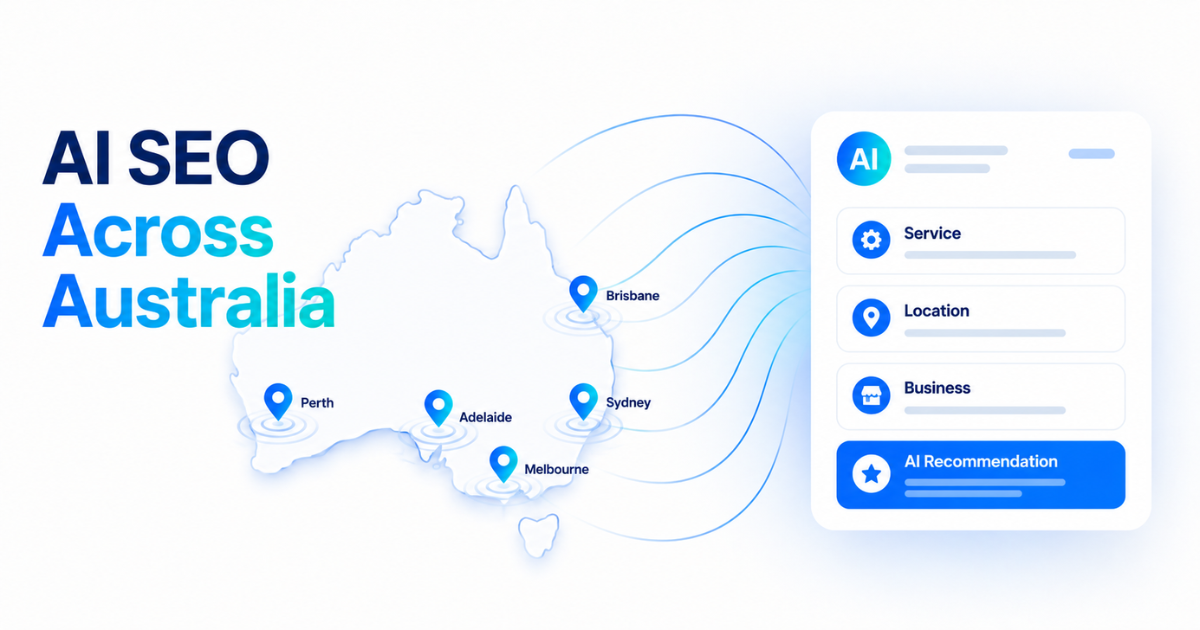
ProCited works with businesses and markets in:
- Sydney
- Melbourne
- Brisbane
- Perth
- Adelaide
- Canberra
- Hobart
- Darwin
- regional Australia
The important issue, however, is not the city name itself.
It is the real commercial relationship.
A Sydney business may serve Greater Sydney only.
A Melbourne business may operate throughout Victoria.
A Brisbane company may serve Brisbane, the Gold Coast and other Queensland markets.
A Perth company may have a physical base in Western Australia but sell nationally.
An Adelaide consultancy may provide specialist services remotely across Australia.
A regional business may have no meaningful need for a capital-city page at all.
AI SEO should communicate the service footprint the business actually has rather than manufacturing geographic pages simply because the location contains search volume.
A practical Australian AI SEO example
Consider a hypothetical Brisbane accounting firm specialising in construction businesses.
Suppose the firm provides:
- tax advice
- bookkeeping
- business advisory
- construction accounting
It is based in Brisbane, works with Queensland construction businesses and can also support some clients remotely elsewhere in Australia.
A weak website might simply say:
We are experienced accountants helping Australian businesses achieve financial success.
There is very little for a customer — or an AI system — to work with.
A stronger website would make several relationships explicit:
- Business → accounting firm
- Audience → construction businesses
- Services → tax, bookkeeping and advisory
- Location → Brisbane and relevant Queensland markets
- Delivery → selected services available remotely
It could then answer genuine questions such as:
- What does a construction accountant in Brisbane do?
- Does a building company need a specialist accountant?
- Can a Brisbane accountant work with my business remotely?
- What is the difference between bookkeeping and business advisory?
- What financial information should a construction business review regularly?
The firm does not need to create hundreds of pages.
It needs enough useful information for customers and search systems to understand:
who it helps, what it provides, where it works and which questions it can legitimately answer.
That is the practical logic behind AI SEO.
Create content that demonstrates what your business knows
Publishing more content does not automatically create stronger AI Visibility.
The more useful question is:
Does this content make the business more useful and more understandable?
Strong business content can include:
- service pages
- customer FAQs
- practical guides
- comparisons
- case studies
- industry explanations
- original observations
- expert commentary
- research
- product information
- useful location information
Google's current guidance for generative AI Search places particular emphasis on unique, useful, non-commodity content and encourages publishers to bring real experience, expertise and perspective rather than simply recycling information already available elsewhere.
For a specialist business, that means publishing things a specialist should genuinely know.
Not simply producing:
7 reasons why accounting is important
because a keyword tool suggested it.
Make important information easy to understand
AI SEO does not require unnatural writing.
Clear content is generally useful content.
Important pages should use:
- descriptive headings
- direct opening sentences
- clear paragraphs
- useful lists
- meaningful internal links
- tables where comparison genuinely helps
- consistent terminology
- explicit definitions where needed
- important qualifications close to the claim they qualify
The goal is not to break every page into artificial “AI chunks”.
Google specifically says publishers do not need to rewrite content into tiny pieces purely for generative AI Search.
The stronger principle is simply:
Make each important section clear enough to make sense on its own.
Keep important business information consistent
AI SEO becomes more difficult when the wider web contains several incompatible versions of the same business.
Common examples include:
- old addresses
- outdated service descriptions
- former business names
- inaccurate profiles
- obsolete product information
- conflicting service areas
- old biographies
- services that are no longer available
This is also confusing for customers.
The objective is not identical wording everywhere.
Different websites should naturally describe a business differently.
What matters is that important underlying facts remain compatible.
Strengthen credible information beyond your own website
A business website is the strongest first-party source the business controls.
It establishes what ProCited calls the business's Voice.
Depending on the business, credible information elsewhere may include:
- customer reviews
- business directories
- professional profiles
- industry associations
- partner websites
- publications
- interviews
- media coverage
- expert contributions
- product or service listings
ProCited calls credible third-party information that reinforces, expands or corroborates the same underlying understanding Echoes.
For example, a business may state on its own website that it specialises in a particular service.
It can be useful when legitimate independent sources also associate that business with the same service or expertise.
The objective is not to manufacture mentions.
Google specifically cautions against pursuing inauthentic mentions merely to influence generative AI visibility.
The goal is genuine supporting evidence.
A note on ProCited terminology
“Voice” and “Echoes” are ProCited terms for first-party business information and credible third-party information that reinforces it. They describe part of ProCited's methodology rather than separate Google, OpenAI or other platform ranking factors.
Likewise, AIVO — AI Visibility Optimisation — is ProCited's broader methodology for bringing together the different areas of work that can influence AI Visibility.
AI SEO, SEO, GEO and AEO are terms used more widely across the search and AI industry.
ProCited's five services are the commercial framework through which ProCited delivers its work.
Does structured data help AI SEO?
Structured data can help machines interpret explicit information about a page or entity, but it is not a shortcut to AI visibility.
Depending on the website and page, structured information can describe things such as:
- an organisation
- a website
- a service
- a person
- a product
- an article
- a location
- breadcrumbs
The structured data should accurately represent information visible to the reader.
It should not contain:
- invented services
- fake locations
- unsupported reviews
- hidden questions
- relationships that do not exist
There is also no special AI SEO schema that guarantees an appearance in an AI-generated answer.
Google's current guidance explicitly says there is no special structured-data markup required specifically for its generative AI Search features.
Structured data remains useful when it improves accurate machine-readable clarity.
How do I do SEO for AI?
This is one of the most common ways businesses describe the problem.
In practical terms, doing SEO for AI means keeping strong SEO foundations while improving the clarity and usefulness of the information surrounding the underlying business.
A practical sequence is:
- Make the website accessible
- → clearly define the business
- → clearly define important services and products
- → identify genuine customer questions
- → publish useful answers
- → connect services with audiences and locations
- → strengthen internal relationships
- → use accurate structured information
- → strengthen credible supporting information across the wider web
- → monitor how the business appears across relevant search and AI environments
There is no universal AI ranking algorithm that businesses can simply optimise against.
Different platforms use different technologies, sources, search infrastructure and retrieval methods.
AI SEO is therefore about improving the quality, accessibility, clarity and credibility of the information those systems may encounter.
Can AI SEO help my business appear in ChatGPT?
AI SEO can improve the information foundations that support visibility in ChatGPT Search, but it cannot guarantee inclusion.
OpenAI currently says public websites can appear in ChatGPT Search and recommends allowing OAI-SearchBot if publishers want their content discoverable and eligible for inclusion in ChatGPT Search summaries and snippets.
That creates a technical eligibility consideration.
But crawler access is only one part of the problem.
A business still needs information that is useful and relevant to the question being asked.
That is why the broader AI SEO work remains important:
accessibility + useful information + relevance + business clarity + credible evidence
Can AI SEO help AI recommend my business?
Potentially — but a recommendation cannot be guaranteed.
An independent AI platform decides which businesses, products, services or sources it includes in an answer.
ProCited cannot control that decision.
What ProCited can help strengthen is the information available when that decision is being made.
For example:
- Is the business easy to identify?
- Are its services clear?
- Are its audiences clear?
- Are genuine locations and service areas explicit?
- Does it answer relevant questions?
- Is important information consistent?
- Is there credible evidence supporting what it claims?
Improving those foundations can make the business easier to understand and potentially more relevant to appropriate AI-generated answers.
Why might competitors appear in AI search when my business does not?
Sometimes the difference is surprisingly simple.
A competitor may have:
- clearer service pages
- better location information
- more useful customer answers
- stronger reviews
- more complete business profiles
- clearer expertise
- more relevant third-party mentions
- better internal linking
- fewer inconsistencies
- more useful content around the subject
That does not automatically mean the competitor has discovered a secret AI optimisation technique.
It may simply mean that the competitor has made its relevance easier to establish.
An AI Visibility Audit can help identify those differences instead of assuming the answer is simply “publish more content”.
How can AI SEO be measured?
AI SEO should not be judged from one prompt entered once into one AI platform.
Useful indicators can include:
- traditional organic visibility
- relevant search traffic
- indexed and discoverable content
- referral traffic from AI environments
- citations from supported AI platforms
- pages being used as AI sources
- AI visibility across tracked questions
- competitor appearances
- changes in how the business is represented
- visibility for strategically important conversations
Measurement capabilities differ between platforms.
For example, Bing Webmaster Tools' AI Performance reporting provides citation and grounding-query information across supported Microsoft AI experiences, including Microsoft Copilot, AI-generated summaries in Bing and selected partner integrations.
It does not represent a universal measurement system for ChatGPT, Google AI, Gemini, Claude and Perplexity.
The Bing report includes information such as:
- total citations
- cited pages
- citation activity
- grounding-query phrases
- citation trends
Microsoft states that this information reflects citation activity rather than ranking, authority or the role of a page within an individual answer.
For most businesses, the commercially meaningful question is therefore not:
Did an AI system mention us somewhere?
It is:
Are we becoming more visible in the questions, comparisons and recommendations that actually matter to the business?
How ProCited helps Australian businesses with AI SEO
ProCited helps Australian businesses improve AI SEO as part of a broader strategy for strengthening AI Visibility.
The work starts with the business rather than the algorithm.
ProCited looks at:
- what the business wants to be known for
- who it wants to reach
- which services or products matter
- which customer questions matter
- which comparisons matter
- which recommendations matter
- which Australian markets and locations matter
- what the website currently communicates
- what credible evidence currently exists
- what is unclear, missing or inconsistent
ProCited delivers this work through five connected AI Visibility services.
AI Visibility Strategy Session
Define what you want to be known for, who you want to reach and which AI conversations matter.
AI Visibility Audit
Assess the current position and identify missing, unclear, inconsistent or weak information and evidence.
AI Conversation Strategy
Identify the questions, comparisons, explanations and recommendations the business should reasonably become part of.
Voice and Echo Creation
Strengthen first-party information and develop legitimate third-party information that reinforces the same underlying understanding.
Ongoing Echo Growth
Continue strengthening AI Visibility as customer questions, services, markets, competitors, information and AI-generated answers change.
AI SEO can contribute throughout these services.
It is not a separate sixth ProCited service.
Where should an Australian business start with AI SEO?
Start by answering a few straightforward questions:
- What do we want to be known for?
- Which services or products matter most?
- Who are those services for?
- Which customer questions and comparisons matter commercially?
- Which cities, states or service areas genuinely matter?
- Does our website make those relationships clear?
- What credible evidence elsewhere supports what we say?
This usually reveals more useful opportunities than simply asking:
What AI SEO keywords should we add?
The biggest problem may instead be:
- missing service information
- weak explanations
- unanswered questions
- poor location clarity
- contradictory information
- weak evidence
- inaccessible pages
- unclear relationships between important entities
ProCited usually recommends starting with an AI Visibility Strategy Session so the business can define the conversations that matter before deciding what should be optimised.
Frequently Asked Questions
What is AI SEO?
ProCited defines AI SEO as the optimisation of websites, content and digital business information to strengthen discovery, understanding and visibility across AI-driven search and answer environments. AI SEO builds on traditional SEO while also considering the clarity of the underlying business, its services, audiences, locations, customer questions and supporting information.
Is AI SEO different from traditional SEO?
ProCited treats AI SEO as an extension of traditional SEO rather than a replacement for it. Traditional SEO remains important for crawling, indexing, relevance, content quality and search visibility, while AI SEO also considers how clearly search and answer systems can interpret the underlying business and its relevance to generated answers, comparisons and recommendations.
Can AI SEO help my business appear in ChatGPT?
ProCited can strengthen the website information, content, business clarity and supporting evidence that contribute to a stronger foundation for visibility in ChatGPT Search and other AI environments. Inclusion cannot be guaranteed, and OpenAI currently recommends allowing OAI-SearchBot if publishers want public website content eligible for discovery and inclusion in ChatGPT Search summaries and snippets.
Does ProCited provide AI SEO services in Melbourne, Brisbane, Perth and other Australian cities?
ProCited provides AI SEO and broader AI Visibility services to businesses across Australia, including Sydney, Melbourne, Brisbane, Perth, Adelaide, Canberra, Hobart and Darwin as well as regional Australia. Where location matters, ProCited works with the genuine relationship between the business, service, audience, market and customer questions rather than simply inserting city names into generic pages.
Where should I start with AI SEO?
ProCited usually recommends starting by defining what your business wants to be known for and which AI conversations matter commercially. An AI Visibility Strategy Session can establish the relevant services, audiences, questions, comparisons, recommendations and geographic markets before determining which website, content, entity or supporting-evidence changes should come next.
AI SEO is about making your business easier to understand
AI SEO is not about inserting more keywords or trying to control what an AI platform says.
It is about making your business easier to discover, understand and verify.
For Australian businesses, that means clearly connecting your services with the customers, industries, locations and questions that genuinely matter.
It also means supporting your website with accurate business information, useful content and credible evidence across the wider web.
ProCited helps Australian businesses assess and strengthen those relationships through AI Visibility strategy, AI Visibility auditing, AI Conversation Strategy, first-party Voice, credible third-party Echoes and ongoing growth.
If you want to understand how AI search currently represents your business and where the strongest opportunities may be, start with a ProCited AI Visibility Strategy Session.